

-
Tactile Ground
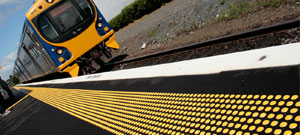
Surface Indicators (TGSI) are designed to give warning of
hazards and directional information to pedestrians who are
Blind, or who have impaired vision, through contact by foot or
cane with the ground surface. Pedestrians with limited vision
use the colour contrast to detect the modules visually.
-
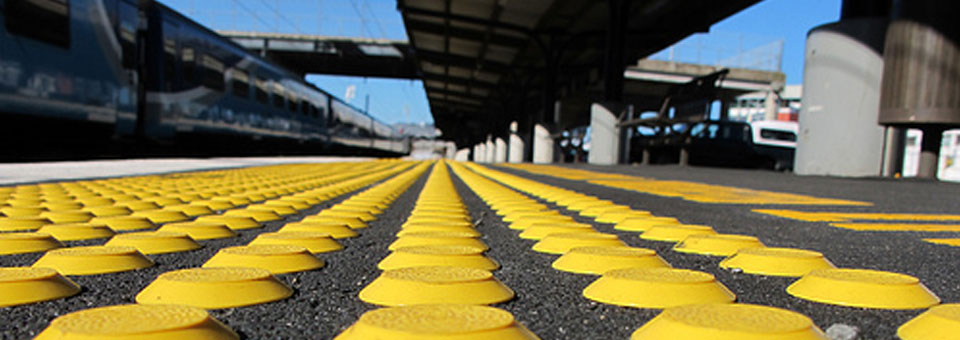
The raised
textures provide alignment on road crossings, highlight dangers
and identify landmarks, using the tactual and visual contrasting
surface.
-
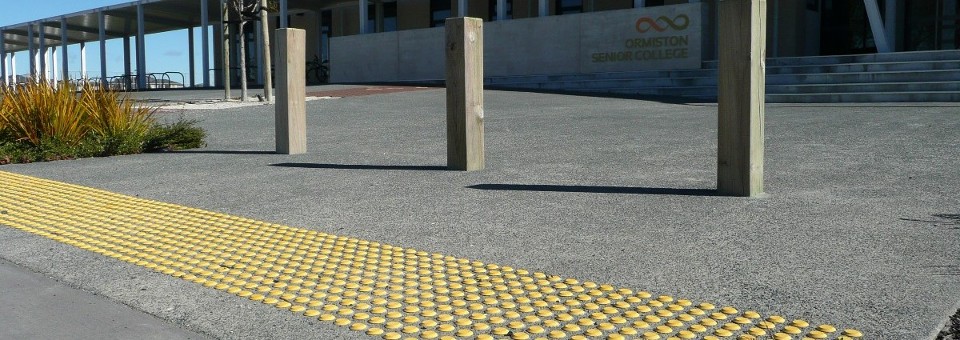
TGSI are
predominantly used at intersections, kerb ramps, pedestrian
crossings and public access facilities.
-
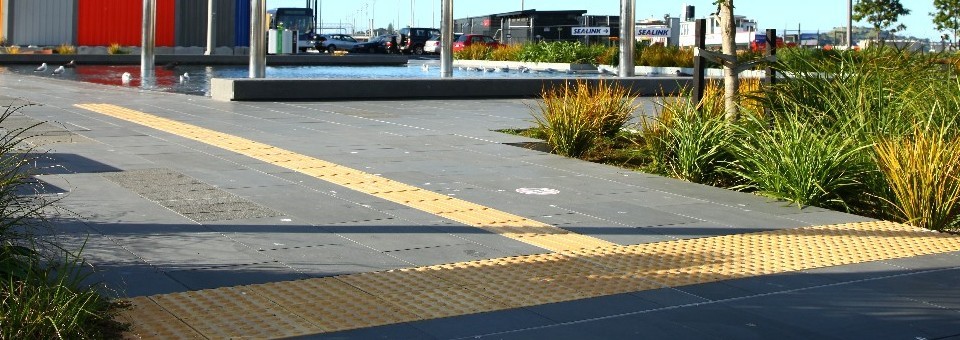
Warning Tiles
indicate crossing points and alignment, while Leading
/Directional Tiles indicate the direction of travel.
-
Land Transport
Safety Authority has recently re-published (September 2003) the
revised RTS 14 – Guidelines for Facilities for Blind and Vision
Impaired Pedestrians. This document is designed for use by
all New Zealand Road Controlling Authorities. It represents
Best Practice design and installation.
-
Standards New
Zealand has adopted a joint Australian/New Zealand Standard
known as AS/NZS 1428.4.1:2009 Design for Access and Mobility
Part 4.1: Means to assist the orientation of people with vision
impairment- Tactile ground surface indicators.
-
These documents
give local authorities the essential direction, satisfying both
design and safety requirements, as well as catering for the
needs of all disability groups. The design is in support of
NZS 4121:2001 Design for Access and Mobility and in harmony
with world-wide standards encompassing the United Nations pledge
to promote the system internationally.
-
Over
70 New Zealand City and District Councils are commendably
incorporating these environmental modifications. Many
Authorities now have progressive policies, actively installing
these facilities at all new and upgraded developments.
-
Disability
groups have welcomed Tactile Indicators, and their incorporation
has been praised by the public.
-
Tactile
Indicators manufactured to required specifications are arranged
through Mobility Research Centre, who will also provide guidance
on design and layout. Mobility Research is working in close
association with the Royal N.Z. Foundation for the Blind and
relevant disability organisations, to ensure the most beneficial
layout.
-
Designers have
a choice of colour, though safety yellow is recommended due to
its clear contrast with standard pavement materials.