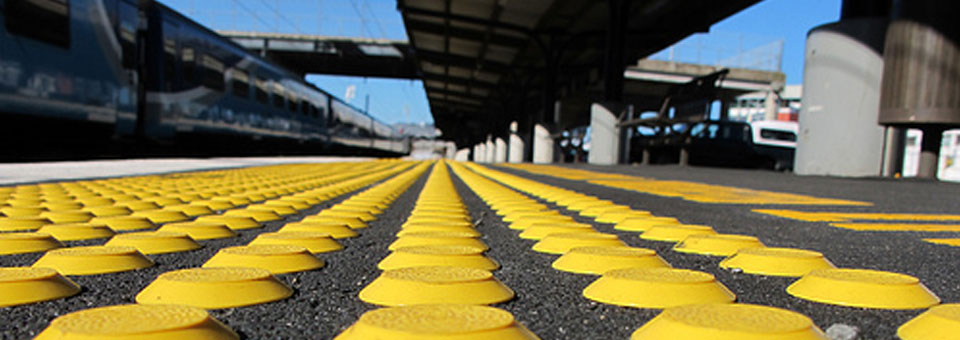
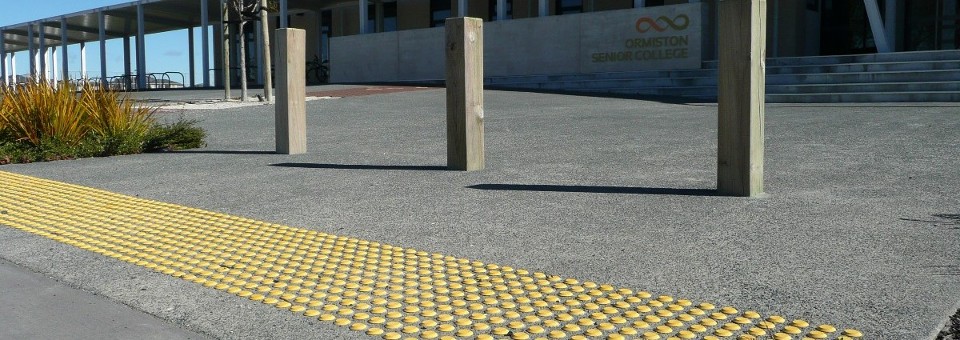

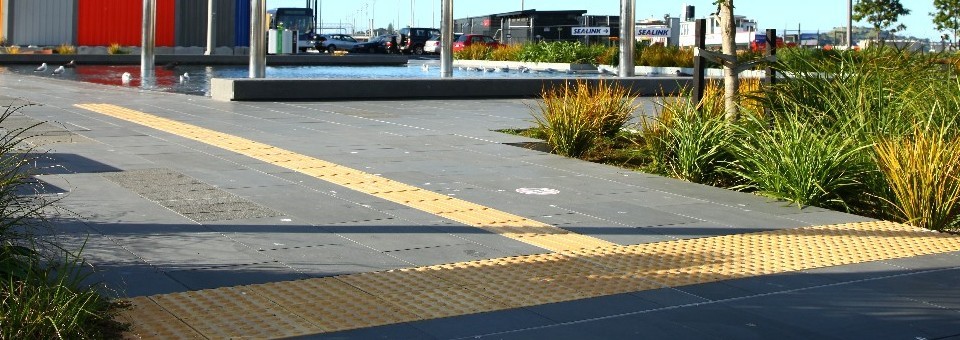


Architects Role in Tactile Tiles:
Whether designing a CBD upgrade, a one-off pram
crossing or pedestrian access to public facilities, Architects play
a vital role.
The general principles for incorporating tactile
tiles are relatively straightforward. Tactile tiles are a specified
textured surface that contrasts in texture and in colour. All
crossing sites including curb ramps, hazardous carriageways, stairs
and median refuges should incorporate tactile warning indicators.
At the concept and design stage the Architects
should incorporate tactile tiles, with reference to RTS 14 and NZ/AS
1428.4.1:2009.
Land Transport Safety Authority's RTS 14
"Guidelines for installing pedestrian facilities for people with
visual impairment" has been published to specify performance
standards for NZ road controlling authorities.
The basis of the document specifies the
incorporation of tactile ground surface indicators at all pedestrian
facilities. RTS 14 also references the joint Australia NZ standard:
NZ/AS 1428.4.1 "Design for access and mobility part 4.1:Means
to assist the orientation of people with vision impairment-Tactile
ground surface indicators ".
Implementation of these requirements ensures that
all Architects and controlling authorities are operating with a
standard approach.
The cement based tactile tiles are easily
incorporated with standard pavement materials. The wide colour
range allows for flexible design enhancing the aesthetics of any
project.
If you do not have a copy of LTSA's RTS14 it is
available through LTSA regional offices. Copies of the joint Aust/NZ
standard are available through Standards New Zealand.
Apart from the national requirements it is likely
your local authority will have a "Standard Detail Sheet"
within Council's roading and traffic policies. This should be
referenced.
Although many of you are already familiar with this design practice
please feel free to contact us if you have any queries.
|