



Information For Contractors On
Pedestrian Facility Upgrades:
Contractors
upgrading or installing new crossings should be aware that Tactile
Ground Surface Indicators are required at all pedestrian crossings.
Tactile Indicators
are designed to give warning of hazards and directional information
to pedestrians who are Blind, or have impaired vision.
National Standards
and requirements for installing Tactile Indicators are set out
within the Joint Australian New Zealand Standard (AS/NZS 1428.4.1:2009) and
Land Transport Safety Authority’s RTS 14.
Apart from the
National requirements, most Local Authorities have “Standard
Detail Sheets” within Councils Roading and Traffic policies.
Tactile Indicators distributed by Mobility Research Centre are in
compliance to all standards and specifications. Implementation of
these requirements ensures that all contractors and local
authorities are operating with a standard approach.
The general
principles for incorporating Tactile Indicators are relatively
straightforward. Mobility Research offers free consultation on
design layout in difficult areas and locations posing engineering
problems.
Types of
Tactile Indicators

Warning (Type B)
Warning Tiles indicate crossing points and
alignment.
300 x 300 x 60mm

Leading/Directional (Type C)
Leading Tiles identify the position of crossing
and direction of travel.
300 x 300 x 60mm
The cement based
tactile tiles are easily incorporated within standard pavement
materials.
Basic Design
Practice
Tactile Warning
tiles should be installed the full width of the crossing and be
900mm deep (3 tiles). The set back distance should be 300mm from
the kerb face and 90° to the direction of the crossing.
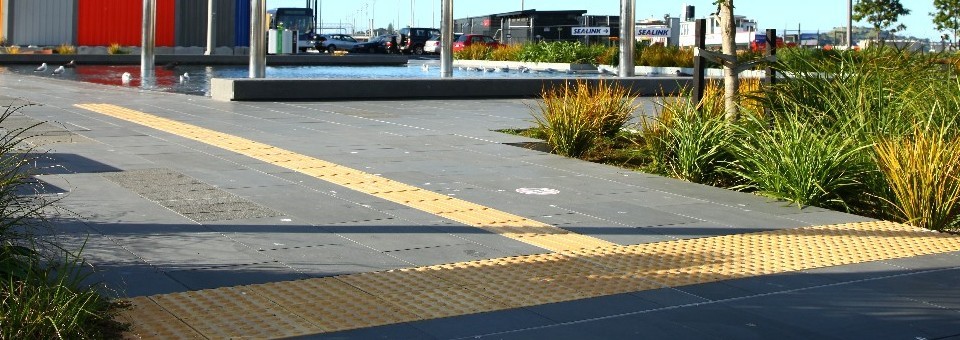
Leading/Directional tiles should be installed where the crossing
points are difficult to locate and where direction of travel needs
to be made clear, for example mid block crossings.
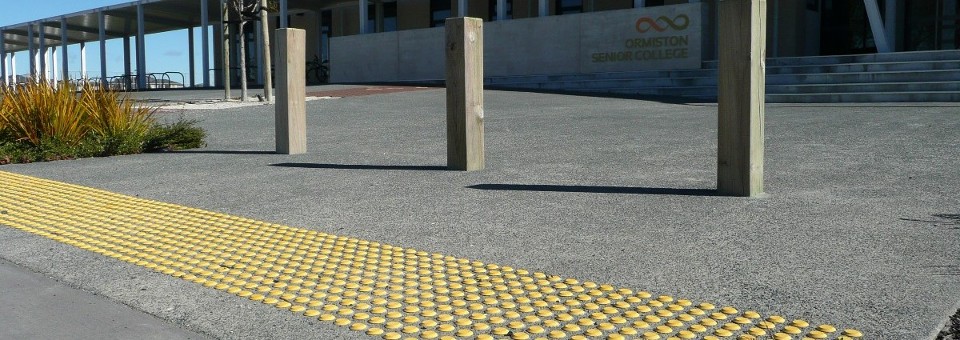
The raised textures
are felt underfoot or by cane. The colour contrast provides
identification for pedestrians with limited vision.
Although many of
you are already familiar with these requirements and design
practice, please feel free to contact us for any further
information.
|